Showing posts with label Brad McEntire. Show all posts

Sep 9, 2019

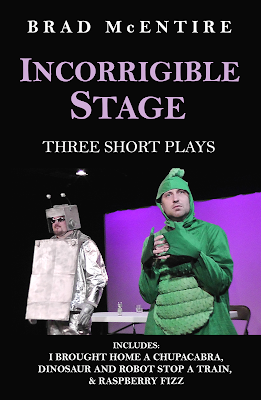
Incorrigible Stage NOW available!


I am pleased to present this little paperback collection of a few of my one-act plays. These pieces are all available individually in ebook format, but I wanted to make a nice book version that would combine them all. Grab one for yourself.

Get a copy... HERE


#   #   #


Perhaps you would be interested in adding more excitement and romance, adventure and intrigue to your life. If that's the case, I don't know what to tell you. But I would suggest you subscribe to my newsletter. I mean, who knows? Life is full of surprises. I only send stuff out occassionally, but it is good stuff. Hit the button below...


Leave a comment. If you are a robot or a blatant marketer trolling Blogger, then you will be deleted. Humans only, please.


Jun 22, 2018

Robert's Eternal Goldfish at the 2018 Minnesota Fringe


I am performing my solo show Robert's Eternal Goldfish at this summer's 25th Annual Minnesota Fringe Festival. I am playing at the University of Minnesota Rarig Center's Xperimental Theatre.

Shows:
Aug 3 @ 5:30 pm
Aug. 4 @ 2:30 pm
Aug. 7 @ 8:30 pm
Aug. 10 @ 10 pm
Aug. 11 @ 1 pm

At the U of M Rarig Center's Xperimental Theatre,
330 21st Avenue S, Minneapolis, MN 55454

Info on tickets and more... HERE.


#   #   #


Perhaps you would be interested in adding more excitement and romance, adventure and intrigue to your life. If that's the case, I don't know what to tell you. But I would suggest you subscribe to my newsletter. I mean, who knows? Life is full of surprises. I only send stuff out occassionally, but it is good stuff. Hit the button below...


Leave a comment. If you are a robot or a blatant marketer trolling Blogger, then you will be deleted. Humans only, please.


Jun 7, 2018

Dallas Solo Fest Q-and-A: Brad McEntire

Producer of the Dallas Solo Fest Brad McEntire [credit: Robert Heart/ TheaterJones]


Chatting with the man behind the Dallas Solo Fest, which runs through Sunday.


published Thursday, June 7, 2018


Dallas — For the final interview of our Dallas Solo Fest coverage, we chat with Brad McEntire, who runs Audacity Theatre Lab and produces the Dallas Solo Fest. This is the event's fourth year (he skipped 2017 because had recently become a father, and to rethink the festival).

The event runs through Sunday at the Rosewood Center for Family Arts (home of the Dallas Children's Theater).

TheaterJones: This year's festival is different from the first three. Tell me about the changes.

Brad McEntire: Since the beginning, the team behind the Dallas Solo Fest, myself included, really have focused on making the festival a little better year by year. This year, we’ve tightened the whole thing up. There are six performers instead of eight, one week instead of two weekends and no daytime workshops. We have also moved the festival to a new venue. We are now in the studio theatre at the Rosewood Center of the Family Arts instead of where we were previously, at the Margo Jones Theatre in Fair Park.

While we have made a few changes, we have kept the good parts that have developed over the last three incarnations of the fest.  We have continued to focus on content-diverse shows to give a good cross-section of what solo performance can offer.  We have also continued the tradition of 70% of the ticket sales going directly to the artists, who still don’t pay any form of festival fee to participate. We even arranged housing for visiting artists who were coming in from out-of-town. We want to insure that the performers get a nice dose of Texas hospitality.

What is your submission/acceptance process? Are you looking for fully formed works? Stuff in development? Both?

The application process began last fall. We received dozens of submissions. A selection committee combed through each submission and we whittled it down to the six that audiences will see at this year’s Dallas Solo Fest.

We are not a “fringe” fest, so we don’t do selection by lottery or on a first-come-first-serve basis. We curate the selection very closely because it is such a focused, intimate festival. I call it a “boutique” arts festival. In place of the big, blustery, street fair-like atmosphere audiences can get at other performance festivals around the country, especially fringe festivals, we are aiming for a more personal experience for both the performers and audiences alike. With just six performers, we do our best to fit the programming together so each show is different and offers a unique theatre experience.

To answer your question more directly, we ONLY look for developed works. In order to deepen and grow the quality of the festival, we have made it a mission to seek out shows that have already played at several venues for several different sets of audiences. There are places that cater to shows in development, allowing artists to experiment and workshop, but we aren’t looking to be one of those kinds of fests. I actually host a quarterly workshop event called the Audacity Solo Salon for that kind of thing. No, we are looking for virtuosity, originality and a bit of hard-won experience from the performers we choose for the Dallas Solo Fest.

You've done fringe and solo festivals for years as a performer. Describe how networking with other artists and presenters on these circuits helped you with Solo Fest.

Independent touring fringe festival artists, particularly those that perform solo shows, are a wonderfully tight-knit community. There are Facebook groups and performers really do kind of keep track of who’s doing what and where.

I have noticed two things again and again when meeting solo touring artists around North America. First, solo performers almost always have an overwhelming sense of enthusiasm. They are real champions for their own shows and like to talk about what they do with audiences and fellow artists. They also are amazingly self-sufficient. Solo performers aren’t just the single actor on stage during their shows, but more often than not, the driving force behind the scenes, too. They are interested in their own marketing, ticket sales, technical requirements, and a bunch of off-stage concerns that traditional actors aren’t always that into. I think this is maybe because the production for a solo performer is by its nature a rather personal endeavor.

Since becoming a dad at the end of 2016, I have, of late, had to curtail a lot of my adventuring around performing my own solo shows. Kiddos, it turns out, take up a lot of time, energy and love. I am slowly getting back into it (I’m off to Minneapolis and Canada this summer to perform my solo piece Robert’s Eternal Goldfish). I hope to strike up some new friendships, see some great new shows, talk with other festival organizers and build out my network more and more.

Despite small audiences for the previous festivals, are your artists generally happy with their experience in Dallas?

On the whole, yes, the performers from the past several years have sent us overwhelmingly positive feedback about the festival and about Dallas. This has been important because one of my personal core beliefs is that the theatre should serve the artist first, then—and only then—the artist can serve the audience and the community.

Crowds have been rather uneven. Some shows sell out, sometimes you can hear crickets. It is especially difficult to market out-of-town performers to local audiences who have little name recognition outside of the fringe touring circuit. Plus, there is a lot of other great stuff happening around Dallas this time of year, such as Kitchen Dog’s wonderful New Works Festival. My hope is that audiences don’t chose one over the other, but instead turn out to both.

The team and I have gone out of our way to really push the content of the shows when marketing. We hope people will see what a given show is about, and then, based on that, decide to come see it.

To make it more worthwhile for the artists, we video shows for performers and drum up as much press for their individual shows as we can. We also offer billeting (touring speak for housing) with local theatre artists acting as hosts. We encourage interaction with audience members before and after the show in the lobby and we do our best to make them feel welcome and appreciated.

What would you like to see for DSF 2019? 2025?

Okay, don’t get ahead of yourself, Mark. If the festival goes well this year, I will do at least one more in 2019. I originally intended to do at least five years of the festival when I started. This is the fourth one. We’ll see. This is really contingent on whether audiences show up and support the event.

I’m not producing in a vacuum. If the message is, “Hey, buddy, Dallas doesn’t want or need this in the cultural landscape,” then that will come through loud and clear. If it fills a gap in the theatre community, then, of course, I’ll keep it going.

Personally, I am an advocate for intimate, indie theatre such as these one-person shows, but I’m not aiming to shove it down Dallas’ throat if it is not wanted.

If it does continue, I can promise we will try to make it better and better. I dream of the Dallas Solo Fest, eventually, becoming a multi-week event in several close together (i.e. walkable to) venues with panel discussions, workshops, open mics and a roster of the best, brightest and most diverse solo shows in the world converging on Dallas. Maybe a food truck or two as well. It would still be relatively small and focused, especially compared to similar festivals, but with a wider range of programming and, perhaps, it would make a slightly deeper dent in the universe. Dallas could potentially become known as a hub for these kinds of shows, bringing in as well as exporting one-person productions. I mean, that’s the dream.

Anything else to add?

Yep, tickets are on sale. The welcome mat is out for audiences. All info one could want is here on TheaterJones and at www.DallasSoloFest.com.


Original post... HERE


#   #   #

Perhaps you would be interested in adding more excitement and romance, adventure and intrigue to your life. If that's the case, I don't know what to tell you. But I would suggest you subscribe to my newsletter. I mean, who knows? Life is full of surprises. I only send stuff out occassionally, but it is good stuff. Hit the button below...


Leave a comment. If you are a robot or a blatant marketer trolling Blogger, then you will be deleted. Humans only, please.


Sep 15, 2015

DSF wins Special Citation


The Dallas Solo Fest, an arts festival I produce through my theatre company Audacity Theatre Lab, was awarded a special citation from the Dallas-Fort Worth Theatre Critics Forum. Here's an excerpt from the Dallas Morning News:


With multiple awards for The NanceHedwig and the Angry Inch and Catch Me If You Can, Uptown Players stood out among the wide range of small companies that scooped up awards from the Dallas-Fort Worth Theater Critics Forum this year. 
While large companies like Dallas Theater Center, AT&T Performing Arts Center, Dallas Summer Musicals and Performing Arts Fort Worth weren’t overlooked, the critics honored gems found in small and less likely venues, from the world premiere of Jonathan Norton's Mississippi Goddamn at South Dallas Cultural Center to shows debuting at the experimental Festival of Independent Theatres at Bath House Cultural Center, the Out of the Loop Festival at WaterTower Theatre and Audacity Theatre Lab’s Dallas Solo Fest at the Margo Jones Theatre in Fair Park.

Special Citations:
To Audacity Theatre Lab and Brad McEntire for bringing quality local and national performances to the second annual Dallas Solo Fest at the Margo Jones Theatre, and for advancing the art of solo performance in North Texas.

So, that was nice. Read the original article... HERE


Jun 4, 2015

The Art of Flying Solo

The Art of Flying Solo
   |   KERA Art & Seek  |  June 3, 2015


Bremner Duthie [credit Alexander Howe]
The ability to stand alone in a spotlight and hold an audience’s attention – that seems a basic requirement for any performer. But more than basic, it can make a performer memorable, vivid. The second Dallas Solo Fest opens this week with eight performers who have very different ways to try to keep us watching — and there’s no one else to blame if they don’t. KERA’s Jerome Weeks looks into the fine art of flying solo onstage.


  • The Dallas Solo Fest runs June 4-14th at the Margo Jones Theatre in the Magnolia Lounge in Fair Park.
LISTEN TO THE AUDIO INTERVIEW.... HERE

Think of solo performance artists, and you’re likely to think of Mike Daisey or the late Spalding Gray delivering their monologues seated at a table. Or perhaps a stand-up comic like Lily Tomlin with the one-woman show, The Search for Signs of Intelligent Life in the UniverseThese are what might be called “minimalist” minimum theater: The artists can play ‘themselves’ or they can portray multiple selves, but it’s one person, one format, one story. This is the theater of talk, albeit often funny talk, compelling talk, full-of-character talk. (And yes, there an even be the ultimate minimalist solo - 'no talk' - as in Marina Abramovic's infamous, seven hundred hours of silence, sitting in the Guggenheim lobby.)


Then there’s the opera-trained singer Bremner Duthie. He’s performing his show, ’33: A Kabarett, at this year’s Dallas Solo Fest. Duthie is more a maximalist performer: he sings, he dances, he clowns, he performs in drag.

“Solo performance comes in a lot of forms,” the New Orleans-based theater artist says. “There’s storytelling, there’s dance, there’s movement. There are solo operas. With every show, I just keep adding things. I’m like, ‘Maybe I could do that and I could also juggle.’”

That wide range of solo styles was one thing Brad McEntire wanted when he created the first Dallas Solo Fest last year. McEntire came up through improv and sketch comedy (the Fun Grip duo) and regular theater (Our Endeavors and Plano Rep). But in 2010, he developed his own macabre-comic solo show, Chop (it’s about amputation enthusiasts — “needless to say,” McEntire adds, “it’s a rather dark comedy”). And he began performing it on the fringe festival circuit – at places like WaterTower Theatre’s Out of the Loop Festival, where he originated Chop.

But there’s fewer than a dozen outlets in America dedicated solely to the solo artist: the United Solo Theatre Festival in New York, for instance, or the Solo Collective in LA or the Women’s Solo Performance Festival in Pennsylvania.

Brad McEntire in his show Chop. [Photo: Audacity Theatre Lab]

"So I decided,” McEntire says, “to just put together the kind of festival that I’d want to go to. And I had met a bunch of solo performers at fringe festivals around the country and kind of tapped into that network. Because there’s a lot of us,” he adds with a laugh. 

Actually, solo performance in different formats has obsessed McEntire for years — long before Chop. He created the Dribble Funk Solo Improv in 2005 and developed the “Monologue Jam” (in which solo improvisers use audience suggestions to “jam” on a storyline). In addition to writing ‘regular’ plays, he hires out, creating “hand-crafted” monologues for people. He’s a tireless founder of things – like the Audacity Theatre Lab, which is officially presenting the solo fest. 

What was different about Chop is that it gained a degree of popularity — McEntire’s still performing it at fringe festivals. So given all this mono-theatermania, it’s not surprising McEntire created the Dallas Solo Fest — and launched a website as well, one dedicated to the art form: TheSoloPerformer.com. He even wrote an e-book, Seven Considerations for the Solo Performer (although, he confesses, the book’s mostly a come-on to get people to sign up for his email newsletter). 

Long before McEntire was setting up shop as a one-man solo-theater factory and before he created his carry-on, show-in-a-duffle-bag productions, North Texas was the home of a godfather of solo theater: UTD professor Fred Curchack (who will play the title role of King Lear this fall for Shakespeare Dallas). Although Curchack has created many more ensemble pieces than solo works, he first gained international acclaim in the ’80s and ’90s for his magical, one-man, performance-art adaptations of William Shakespeare: Stuff as Dreams Are Made On (akaThe Tempest) and What Fools These Mortals Be (aka A Midsummer Night’s Dream). 

Curchack’s cross-cultural, Jungian-mythological, self-referential mash-ups take the solo show about as far as it can go as a “world art,” a world-encompassing art form. This is theater with an almost Joycean density of wordplay and ritual — if James Joyce ever managed to work Balinese masks and dance moves into Finnegans Wake. Head down that particular rabbit hole, and you’ll find exotic, younger, maximal soloists like Taylor Mac, who sees no ‘purity’ in the theater arts, he mixes them all. Nor does he see any divisions between self and stage character — they’re just larger or smaller versions of his same, sweet, gay flamboyance. 


UTD professor-performer Fred Curchack
Like Mac, Curchack, even in his most maximalist shows, however, will sometimes touchingly, sometimes self-indulgently, bring everything back to just himself, the poor forked creature onstage. Come for the magic, stay for the all-too-human — yet a human who can still, somehow, hold a spotlight. 

Solo artists may have an ancient pedigree going back to preachers, medieval minstrels and shamans around the fire, but the current ones are more likely to draw on modern theories such as Grotowski's ‘poor theater,’ Debord's ideas on the 'spectacle,' vaudeville, stand-up comedy, post-structuralism -- or just their professional need for making-do and getting-paid. 

McEntire certainly embodies that last, the all-American, self-reliant, DIY impulse. It can be found in his welter of websites, labs, formats and the solo fest itself. “I’m not averse to collaboration and doing traditional ensemble theater,” he says. “But I firmly believe in self-instigating theater artists. Which is not how we are usually trained as theater artists. We’re trained to play our roles. And I think there’s a place for that. But I think in contemporary times, the artist is more entrepreneurial.” 

For his part, Duthie followed the familiar path of frustration — exiting a typical stage career and entering solo entrepreneurship. He started performing his “one-man musicals,” he says, after years of trying to make it as an opera singer. He performed in the kinds of “really terrible productions” that make a performer happy simply because he got cast. “And I was doing the rounds auditioning as a working actor doing commercial stuff.” He sighs. “And I just wasn’t enjoying it. But I had this little idea for a show about Kurt Weill and the Weimar.” 

And it became a hit — he’s toured ’33: A Kabarett around the country, to London, Scotland and Canada, in addition to performing concerts. 

This is the performing artist as independent contractor — a very contemporary, libertarian-free-market idea, although for performing artists, the fact of having to do-it-all-yourself is as old as busking. Or perhaps, this is the performing artist as obsessive-compulsive, the narcissist who must control everything, every detail. And who isn’t about to share the spotlight. 

But, strictly speaking, Duthie is not a “solo artist” — as if he were the lone creative agent here, like a painter or sculptor. Instead, as with many solo artists, he publicly credits the directors, choreographers and researchers who actually helped him shape the works he writes and performs. This is still theater — somebody’s gotta take the tickets, operate the lights and sound. It’s always a cooperative venture, somehow. 


Bremner Duthie in ‘33: A Kabarett. [Photo: Alexander Howe]
So how do we distinguish these new sorts of ‘entrepreneurial soloists’ from traditional magicians or singers or that guy who twirls plates? 

Both McEntire and Duthie say it’s the narrative. Amid all the singing and joking, solo artists must tell a tale. The story in Duthie’s show ’33 is in the title. Adolf Hitler became chancellor of Germany in 1933. 

“When Hitler took power in 1933,” Duthie says, “he didn’t have the power yet to attack the homosexuals, the Jews, the Gypsies and all the people he wanted to get. But he did have enough power to close down and censor the theaters and the cabarets.” 

That’s why 1933-’34 saw the great exodus of Germany’s experimental artists: Kurt Weill, Bertolt Brecht, Arnold Schoenberg, Heinrich Mann, George Grosz. They fled because some of the first people sent to what were then the Nazis’ “re-education” camps were theater performers and satirists. 

The Weimar Republic’s angry, enthusiastic burst of unconventional sexuality, social unease, economic privation and disturbing art was over. Of course, all of this sounds perfectly familiar to us because of the Kander-and-Ebb musical, Cabaret. But remember, that was a Broadway show. The era — and the art of that era — have more bitterness, more pathos, than Willkommen, bienvenue, welcome

In Duthie’s performance, an actor comes to his now-ravaged cabaret, only to find his fellow performers have all been dragged off. “But he decides to stick around and do a tribute to his disappeared friends – the singer and dancer, the comedian and the showgirl – and do their acts as best he can,” says Duthie. 

So it’s a retrospective, a farewell to what the Weimar once was. But Duthie’s performer decides to stick around to sing and dance only because we’re here. His audience. The audience is one of the seven considerations McEntire writes about for solo performers. The audience “frames” the performance: Where is this little chat taking place? Who is listening and why? The performer has to decide who the audience is to tell the story she wants to tell. Is she pleading her case to a judge and jury? Is this a lecture? Perhaps the audience is essentially a therapist or a fellow barstool-warmer, which is why we’re listening to the actor’s life story. If the audience is “just” another theater audience, then that’s a choice the performer makes — and that will dictate how (and even if) the performer can interact with theatergoers. 

“Most solo performers speak directly to the audience in some way,” says McEntire. “So the audience is your partner. Not somebody else on the stage. The audience.” 

Which would seem to mean no solo performing artist is ever truly alone. 


Original article... HERE 

[NOTE: This might be the most thoroughly researched article I have ever appeared in. Mr. Weeks dug around online to uncover a lot of stuff I did not tell him directly, including uncovering Dribble Funk and the Monologue Jam.]


Apr 26, 2015

WE MISS ALL THE GREAT PARTIES book release


My friend David Hopkins is doing a book release next week. Here's the info...

thatdavidhopkins.com presents: CAKE AND PROSE, a unique presentation of essays, short stories, and music... plus cake! Let's not forget the cake.

I am part of the evening. I'm reading David's piece "Shopping Mall at the End of the World"

Cake and Prose is Friday, May 1st at the historic Margo Jones Theatre in Fair Park, 1121 First Avenue, Dallas TX 75210. The event will feature readings from WE MISS ALL THE GREAT PARTIES, performed by great local actors ( besides myself, you can also see Bryan Pitts and Maryam Obaidullah Baig). 

Plus, live music by the talented Greg Schroeder.

Admission is a pay-what-you-can donation to The Birthday Party Project, cash or check accepted. It's a wonderful non-profit that brings joy to homeless children throughout the Dallas area.

The event starts at 7:30 PM and will probably last about two hours.

Some information on parking:
 http://www.margojonestheatre.com/directions--parking.html

Copies of WE MISS ALL THE GREAT PARTIES will be available for sale (both paperback and hardcover).

Facebook Event page at: 
https://www.facebook.com/events/1390010577987158/permalink/1390010984653784/


Dec 12, 2014

CYRANO A-GO-GO at Solo Salon

"Brad McEntire"

I recently had the opoortunity to read an excerpt of my solo show CYRANO-A-GO-GO at the Audacity Solo Salon. I got some great feedback from the dozen and half audience members that turned out.

I was on a roster with Adam A. Anderson and Kris Noteboom. They rocked it out with their pieces as well.


Adam Anderson, Me and Kris Noteboom


Jun 8, 2014

A DSF Debriefing on TheaterJones.com


A Solo Debriefing

Brad McEntire, producer of the recent Dallas Solo Fest, on what he learned from the project.

published Friday, June 6, 2014

DALLAS - Recently, under the banner of my small theatre company, Audacity Theatre Lab, I produced the first ever Dallas Solo Fest, a fringe-like celebration of one-person theatrical performance. The goal was to introduce Dallas audiences to a wide range of solo performances styles as well as raise awareness of the format in the north Texas area. To that end, I brought together a curated collection of solo performers from around the country along with several local favorites.

I have been producing for years and though the festival was small by arts festival standards (with only eight productions), this was the largest event of this kind I’ve ever attempted. I am a hands-on producer and by virtue of the way Audacity Theatre Lab is set up, I was the sole staff member until right before the festival began. The project presented several challenges, but ultimately it went over pretty well.

Here’s what I learned…

Get a Grant

When I began planning the Dallas Solo Fest back in the summer of last year, one of the people I reached out to was Grant Knutson. Through his group Minion Productions, he serves as a sort of consultant/coordinator/coach for fringe performers aiming to tackle the many “fringe” theatre festivals around North America.

Fringes are generally distinguished by short, unconventional performances and low-cost tickets with a large share of ticket sales returned to artists. Many open their stages to amateurs as well as seasoned acts.

Upon its launch in 1947, the Edinburgh International Festival of performing arts was eclipsed by a more grassroots event. In makeshift performance spaces around the city—"round the fringe" of the official performing arts festival, as one journalist put it—artists began mounting small-scale, independent performances. There in Edinburgh, Scotland, the "fringe festival" concept began. It has since spread all over the world.

Grant was curious about how I was putting together a national festival from the ground up and I was curious to pick his brain. He currently sits on the board of the Fresno Fringe and has assisted administratively behind the scenes of several other festivals. So, he, like me, had worked on both sides of the curtain: the artist’s side and the administration side. He also knew several of the artists in the Dallas Solo Fest personally from his own travels. He offered to come down during the fest and help and I took him up on it.

I am so glad I did. Besides supplying lots of good ideas, observations and being a great sounding board, it was good to have another set of hands. Besides the board operator Shea Smith, the staff during the festival itself consisted of me, my wife Ruth Engel and some on-again-off-again support from fellow Audacity artist Jeff Hernandez. Grant did everything from updating social media to taking out trash. And he did it all with a positive attitude.

To have one more informed and good-natured staff member made the whole event much more manageable. My recommendation to anyone doing a festival like this in the future… you should also get yourself a Grant.

Plan for the Unexpected

On the first Saturday of the Dallas Solo Fest, around 3 o’clock in the afternoon, I learned there was going to be a thousand people right next door to the Margo Jones Theatre in a matter of hours. They would be celebrating something called Bayou Bash. Needless to say, this took me by surprise. The Bayou Bash is a huge picnic-style fundraiser for Alumni Association of Southern University, complete with outdoor DJ and authentic Louisiana cuisine. They had rented the African American Museum next door to the theatre and had spread onto the balcony of the theatre itself.

They did not know we were going to be at the Margo Jones and I didn’t know they were going to be throwing a loud party next door at the Museum until right before our respective events.

For the most basic of productions, the unexpected will happen. For a festival with so many moving parts I learned this phenomenon increases a hundred fold. Actors had flights cancelled, keys to billets didn’t work, last minute props had to be located, audiences went to the other Margo Jones Theatre (the one at SMU), typos were found on flyers after bunches were printed and so much more.

The whole two weeks was an extended exercise in constant problem-solving. On top of this, if things went smoothly, no one was the wiser. If problems occurred, everyone knew. Though it was certainly stressful, it was also a wonderful challenge…and even kind of fun.


Love the Locals


The three locals brought in their respective audiences, they delivered great performances, and more importantly they served as excellent representatives of Dallas.

Elaine Liner, Danny O’Connor and John Michael could have retreated into exclusively marketing their own shows, just shown up to do their techs and performances and not really been a part of the overall festival beyond simple participant. That didn’t happen. They totally stepped up and got the word out.

Elaine, Danny and John met and chatted with the out-of-towners. They showed genuine enthusiasm for the festival.  The individual and rather disparate crowds of Elaine Liner, Danny O’Connor and John Michael really made the festival a distinctly “Dallas” event. And an economically feasible one at that.

Not only did they perform some kick-ass shows, what I am most proud of is that they were great ambassadors for Dallas, especially to the out-of-town artists. Elaine, Danny and John welcomed the traveling performers with open arms. They held and attended workshops. They bought beers and talked shop.

I was so pleased to have these three particular local performers, each in his or her distinct way, represent the cultural landscape of Dallas so well.

Just Ask

The Dallas Solo Fest received sponsorship and partnerships that helped make the event an even bigger and better.

Uber, the car service app, partnered with DSF and supplied $20 credit vouchers for Dallas Solo Fest patrons who became first time Uber users. They allowed us to send out a promo code to our mailing list. We gave Uber cards to festival pass holders, Kickstarter supporters and workshop participants. Cards were given to the out-of-town artists (a great perk in a car-city like Dallas).

How did this Uber partnership happen? Well, I asked them. And they said "yes."
TheaterJones became our official media sponsor. They ran preview articles, profiles of the performers and reviews of all eight shows. They created a special section on their website for the Dallas Solo Fest. It worked out for both parties. It drove traffic to their website and the DSF profited from the exposure.

How did this TheaterJones sponsorship happen? Well, I asked them (and then one of the local performers also asked them). They said “yes.”

Before the festival, I created the ultimate “ask” with a Kickstarter campaign. I asked for monetary support and 34 different people stepped up, donated to the cause and said “yes.” The outstanding Kickstarter supporters helped establish the potential of the fest. They made the initial awesomeness possible.

I have learned not to underestimate the power of simply asking.

Good Vibes Go a Long Way

One bad apple could have spoiled the whole barrel, but that didn’t happen. All the performers, even the ones who had travelled from half-a-country away, were positive and humble. There were no divas. Everyone was patient and courteous and, most importantly, professional.

The audiences spanned a wide range of demographics. All were welcome. We tried to maintain a casual atmosphere in the lobby between productions, encouraged talk with the artists outside after shows and most of the performers gave little-shout outs to the other performers or the festival as a whole from the stage after their shows.

I truly believe the positivity and enthusiasm was infectious. It was generated by the organizers, and spread to the artists and patrons. It went a long way to making the festival a really fun event.
My hope was that the artists traveling in from out of town would leave with a good impression of the city as well as with their experience at the Dallas Solo Fest. From the feedback I have received so far, that has been the case.

Overall, the Dallas Solo Fest was a challenge, but a really enjoyable, educational one. Maybe I’ll have to do another one in the future…

» Brad McEntire is the artistic director and founder of Audacity Theatre Lab, and the founder of the first Dallas Solo Fest.

Original post HERE.


Jan 29, 2014

ROCKET PACKS, TIGERS AND GOLDFISH - feature in StarLocalMedia.com's Going Places

Kelley Chambers of StarLocalMedia.com did a wonderful Q-and-A with me this week...

Going Places: Rocket packs, tigers and goldfish

By Kelley Chambers | Carrollton Leader | January 29, 2014
Brad McEntire stars as Robot and Jeff Swearingen as Dinosaur in “Dinosaur and Robot Stop a Train.” The one-act play, written by McEntire, premiered as part of the 2013 Festival of Independent Theatres last June at the Bath House Cultural Center in Dallas
So far, 2014 holds some new and promising endeavors for director and playwright Brad McEntire.
Known for his passion for creating small yet powerful theatre productions, the Carrollton native’s latest production of director Andy Eninger’s “The Last Castrato” at the Margo Jones Theatre in Dallas wrapped last week with glowing reviews. Also earlier this month, his production company, Audacity Theatre Lab, hosted McEntire’s solo piece, “I Brought Home a Chupacabra” as part of the YOLO Solo Fest of one-person, one-act plays.
Catch another one of McEntire’s own off-the-wall solo pieces, “Roberts' Eternal Goldfish,” when it debuts at the Out of the Loop Fringe Festival at the WaterTower Theatre this March in Addison.
“I’m trying to do high-quality professional theater that doesn’t cost much. It’s not a stepping stone to get to something bigger - the goal is the small.”

SLM: How did you get your start in the local arts community?
BM: “I started Audacity Productions in 1999 while in New York. We did a reading at Art Centre in Plano – that was the first thing we did. It was a total garage band sort of operation. We dissolved in 2006 [when] I moved to Hong Kong … and I made a new company named Audacity Theatre Lab in 2008. Now we’re trying to do real gritty, small in scale but big in scope [shows]. That’s been my rallying cry.”
SLM: With plays named “Chop” and “Dinosaur and Robot Stop a Train,” how would you describe your style? And how do you come up with this stuff?
BM: “My wife said it best when she said ‘you blend kitsch and resonance.’ I like dinosaurs and jetpacks and tiki gods; I like all these kinds of novelty things, but I like for them to serve a purpose, to serve the message of the play. I write the stuff I want to see, because nobody is writing the stuff I want to see. The Dallas theater community is pretty big, and there’s enough room in it to do [what you want to do].”
SLM: Any other influences besides your own imagination?
BM: “[Daniel Quinn] who wrote the book “Ishmael” wrote another book [called “Beyond Civilization”], and he has this theory of tribes in it. His thesis is that when humanity turned to civilization, we mucked everything up. Civilization works as a big hierarchy. Quinn's thought was if we still lived tribally, we would be more plugged in rather than living in a hierarchy where status tends to trump results.
His writing was very influential on me because it sparked this thought... what if everybody was their own "tribe?" Instead of the traditional hierarchy in theater, where designers design, directors direct and the actors act and everyone answers to someone above them on the food chain …you could have a theater company composed of people who could do all the roles in a tribe – we could even trade off if we needed to. I like this idea so much, but we’re very role driven people. Especially people in the theatre. It’s a collaborative art form. It’s very hard to convey [this tribe-of-one idea], and it’s very hard to get people who usually just interpret something someone else made to understand it. There's a risk in it. You are responsible for your idea. You are an instigator.”
Carrollton native Brad McEntire started Audacity Theatre Lab in 2008, but his humble beginnings with his production company began at the Art Centre in Plano, where he hosted a “garage band style” reading. Since then, McEntire has built upon his company and is well-versed in directing, writing, improvisation, cartooning, and probably a few other talents related to the arts community.
SLM: You write and direct on your own plays – doesn’t that keep you extremely busy?
BM: “It does, but only when I want it to. We don’t manage a space, we’re invited to play. When we’re there at the Margo Jones Theatre in Fair Park [where Audacity Theatre Lab is one of a few invited groups] we pay in sweat equity. The rest of the time we’re not there, we don’t manage the space so we don’t have to keep money coming in. If the artists in Audacity don’t have any ideas, we simply don’t do any theater, and if we have a lot of ideas, we do a lot of theater. The time schedule’s really organic. There's really low overhead, so there's really no need for a constant stream of income. Most theaters don’t operate that way. They have to fund raise constantly and stay relentlessly active in order to keep the doors open. We found that we have a lot of freedom by just not having any doors.”
SLM: Where all have you hosted your productions?
BM: “All over the place. The Bath House Cultural Center, WaterTower Theatre, Teatro Dallas, the Ochre House in Dallas. We’ve done stuff at Starbucks, in art galleries, and we’ve done stuff in lobbies of apartment buildings. We in Audacity put the project together, then we think, ‘Where can we do this?’ The goal itself is not to get as large an audience as possible but to get an audience that is as interested, as engaged as possible. Most of our shows are meant for intimate spaces, for small audiences.”
SLM: You seem to see theater a bit differently than most. What is your theory or your plan of attack when it comes to producing good stage productions?
BM: “First and foremost, we shoot for quality. That's a given. Small-in-scale theater is one of those things that often gets a bad rap, because it’s considered amateur. I’m trying to do high-quality professional theater that doesn’t cost much. It’s not a stepping stone to get to something bigger, the goal is the small. The good thing is nowadays in order to run a theater all you need is a laptop for all the administrative stuff. And for the production side, we’ve streamlined it so that all we need, most of the time, is what can fit in a dufflebag or two.”
SLM: How has the feedback been so far?
BM: “The shows have been well-received. Reviews are mostly good. The trick is getting the word out. I am actively  learning the marketing side of things just now."

"I am slowly earning recognition from my colleagues, though that is very gradual. One observation I've made, is that the more I turn to creating and producing my own work under my own banner [AudacityTheatre Lab] the more I feel kind of isolated from the greater theater community here in North Texas. This has been more pronounced since I began working on solo shows over the last few years. I now have to make more of an effort to get out and participate in the cultural landscape and to keep track of what my fellow theatre professionals are doing."

"I’m at a point in my career where I can proudly put my name on everything I make. I’m kind of now in the early middle days of my playwriting and producing , so I’ve gone through the [preliminary work] that was needed. I've been at this for over twenty years. I have a lot of experience and training under my belt. I'm proud of pretty much everything I turn out now. That wasn't always the case as I was coming up. So, that's a thrill. There’s no apology. There's no saying, 'Oh, it's okay if you don't see this one, maybe catch the next one...' Everything is pretty solid and thought-through and I'm usually really pleased to present any new project to my audiences. Now I invite everyone I know to come see everything I do.”
For more information about Brad McEntire, visit bradmcentire.com.